Friday, 13 January 2012

Crystal Castles Interview in The Daily Yomiuri on 14th January 2011

Crystal Castles anything but fragile
Stephen Taylor / Special to The Daily Yomiuri
Ethan Kath, of Crystal Castles, backstage at
 the Roundhouse on 15th October 2010

LONDON--Of the many reasons drummers have given for quitting a band, not wanting to wear lingerie is one of the more unusual. But that's exactly what happened when Crystal Castles was about to take the stage at Summer Sonic in 2008.

"I found a pair of Alice's stockings and I cut them in half and put one on," Ethan Kath, the band's producer and songwriter said, referring to the band's singer, Alice Glass. "I gave [the drummer] the other one to put on, and he refused. He was like, 'I'm not going to play in stockings,' and that was the last time I played with him.

"I wanted us to have matching stockings."

The band will play concerts in Osaka and Tokyo next week with replacement drummer and Kath's long-time friend, Chris Chartrand. "We can't wait to go there. We played Summer Sonic in 2008, and we've been waiting since then to return," he said.

Formed in 2004, Crystal Castles released its eponymous debut album in 2008. An untitled follow-up came out last year and made it onto the Best Albums of the Year lists in both Spin Magazine and New Musical Express. Crystal Castles owes much of its sound to the dark, brooding influence of Fiction label mates The Cure. In fact, that band's vocalist, Robert Smith, sings on the group's latest U.K. single, a version of Canadian band Platinum Blonde's "Not In Love," which also appears on Crystal Castles (II), sans Smith. Kath sees the group's recorded output and live sound as distinctive entities.

"[On record] we have some songs that sound like sad, isolation, really icy, and then we have other ones that are really abrasive, with Alice screaming over them. Our shows are the opposite of the isolated feelings of our records--it's more communal. We're in this together, we're gonna sweat on each other, spit on each other, bleed on each other: It's just like a pile of wet flesh," he said.

Kath's assessment of the group's live concerts is no understatement, with Glass spending most of her time on- (or rather off-) stage surfing the crowd and getting mighty sweaty with the mosh pit. Kath was struck by Glass' confrontational approach toward fronting a rock band when he saw her singing with Fetus Fatale in 2003.

"The time I went to check out her band, there were legends [there] from the Toronto '80s punk scene...and they were heckling the band. Alice was [taking a] mouthful of beer, spitting it into their faces and telling them to f--- off. At that time, she was just 15 and I couldn't believe what I was seeing. I thought she was amazing and powerful and I knew that I had found my dream front person," he recalled.

Years later, their shared love of punk has become their profession, one that requires new shots of inspiration. "We like collecting old punk records and when we were in Japan we found this amazing store in Tokyo that had every dream punk seven-inch you could ever hope to find, and we look forward to going back to that store. We found it by fluke, we were just walking around and saw a sign saying, 'Punk and Hardcore Vinyl,' and we were like 'Whaaat?' It was the best punk store in the world."

Crystal Castles will play Club Quattro in Osaka, at 7 p.m. on Jan. 17. (06) 6281-8181; and at the Liquid Room in Ebisu, Tokyo, at 7 p.m. on Jan. 18. (03) 5464-0800. For more information, visit www.creativeman.co.jp/artist/2011/01crystal.
(Jan. 14, 2011)

Corinne Drewery (Swing Out Sister) Interview in The Daily Yomiuri on 5th November 2010

Still swinging after all these years
Stephen Taylor / Special to The Daily Yomiuri

Corinne Drewery in Dalston, London, in September 2010
LONDON--For most artists, a tour of Japan usually coincides with the release of their latest album, yet when Swing Out Sister strike up at Billboard Live in Osaka on Thursday, it will be almost three years since the British group's last album, Beautiful Mess.

"We're working on some stuff. When we have our own place and our own studio, it tends to take longer, because you haven't got the deadline of starting and stopping when you're booked into a studio," singer Corinne Drewery said in an interview for The Daily Yomiuri at the group's studio.

"We can change our mind, we don't have to stop at the first conclusion or the first decision. I think it's a more organic creative experience when you've got your own studio, 'cause you can just stay all day, all night, but it tends to go on indefinitely sometimes. We've changed our mind about the album we're doing several times, but it's a mixture of old and new, referring to some things from the past, but taking them to new places," the 51-year-old said.

Drewery and musical partner Andy Connell, who form the nucleus of Swing Out Sister these days, have enjoyed success in Japan since the 1980s and earned themselves a Recording Industry Association of Japan Grand Prix Single award in 1996 for the single "Now You're Not Here," after it had been used as the theme song for the popular TBS drama Mahiru no Tsuki (Midday Moon). Twenty years on, what can the group's legions of fans expect on stage this time around?

"I think we'll reinterpret some of the songs, if we're doing some of the same ones, and there'll be some different songs, some newer songs added. We have a flugel horn player with us, so that makes for a different sound," Drewery said, adding that it's unlikely they'll be resorting to any radical methods of mixing things up.

"I suppose everybody could swap instruments one night or wear each other's clothes or sing the songs backwards," she said with a laugh.

Swing Out Sister's jazzy style of pop is well-suited for the sophisticated surroundings of cabaret venues, where listeners enjoy music between mouthfuls of pasta. Drewery is conscious that getting the audience grooving requires a slightly different approach.

"Somewhere like the Billboard venues, where people are coming for dinner and then they're watching a concert after dinner, I don't know if it'll give them indigestion to get them up jiving and twisting straight after they've eaten," she said with a giggle and speculated on what best suits the group's audience nowadays.

"I think people do want to be part of what you've created, as long as it's at the right point and it's nearer the end, everyone seems to want to join in. We've got quite a mature audience--though there are a few young whippersnappers--so I don't know if people would want to stand up and dance for an hour."

Drewery reckons that she has made more than 30 trips to Japan since first touching down in Tokyo in the early 1980s after being plucked from London's night club scene as an amateur model for a Japanese fashion company. Whenever she is in the country, a trip to an Ippudo ramen shop is always near the top of any must-visit list, having received some special service from the chain's founder after discovering the food that made Hakata famous when the band played in Fukuoka a few years ago.

"Shigemi Kawahara invited us to his restaurant, donned his apron and promptly began cooking," Drewery recalled, adding she wasn't aware of the enormity of what had just happened. "His business manager, Ted Matsumoto, was visibly shocked and said, 'I haven't seen Shigemi cook in one of his restaurants for years,' so I said, 'But I thought he was a chef,' only to be told by Ted, 'Yes, but he only cooks on TV!'"

After a tasty bowl of ramen, Drewery can think of nothing better to wash it down with than a uniquely Japanese beverage.

"Calpis is the thing I crave as soon as I arrive in Japan--sparkling in a can, still in a bottle or concentrated to add to water or cocktails. I always bring a few cartons home," she said.

Swing Out Sister will play at Billboard Live in Osaka on Nov. 11-13, (06) 6342-7722, and Billboard Live in Tokyo on Nov. 15-16 and Nov. 18-20. For more information, call (03) 3405-1133 or visit www.billboard-live.com.
(Nov. 5, 2010)

Feeder in The Daily Yomiuri on 10th September 2010

20 yrs on Feeder's Hirose still rocking U.K.
Stephen Taylor / Special to The Daily Yomiuri
Taka Hirose in Holloway, London, on 16th August 2010

LONDON--When Taka Hirose left Japan to study in London nearly two decades ago, earning a living as a member of one of Britain's most successful indie bands could not have been further from his thoughts.

"When I came to London I never, ever imagined I would be a musician, so life is strange, isn't it?" the Feeder bassist said in an interview for The Daily Yomiuri during a break from rehearsals in north London for the group's upcoming tour of Japan, which opens in Fukuoka on Saturday.

Hirose's strange journey began in the early 1990s, when he placed an ad in a local newspaper that was answered by a couple of Welshmen--singer/guitarist Grant Nicholas and drummer Jon Lee--who asked him to join their new band, Feeder. Four years after its 1997 debut album, the group's Echo Park album exposed the three-piece to a wider rock audience.

The tragic suicide of Lee in January 2002 left Feeder effectively in the hands of Hirose and Nicholas. Lee's replacement, Mark Richardson, left last year, with new sticks man Karl Brazil joining in time to record the band's latest album, Renegades.

The record's release at the end of June was preceded by a Tokyo showcase that drew heavily from the new album. Hirose was pleased with the reaction to the new material.

"From this album, 'Call Out' was more popular than 'Renegades' when we played at Daikanyama Unit, but there's a song called 'Down By The River,'...that song is very popular both in Japan and here," he noted.

The gig in Tokyo ended with "Just a Day," a crowd pleaser that first emerged as a bonus track on the Japanese release of Echo Park in April 2001--seven months before it's British release--which may explain why the song generates such mayhem among audiences in Japan, as captured on a video that appears on the Feederweb channel on YouTube. Hirose recalled the moment well.

"I suggested to the other guys, 'Why don't we invite the audience on stage for the last song? They're really well-behaved kids, it should be good fun.' I said [to the audience], 'If you want to, come on stage,' so gradually more and more came, and when I said, 'That's enough,' more and more came and we ended up with a lot of people on stage. It was quite good fun," he said with a laugh. The song's official promotional video, in which another group of fans play a hilarious starring role, is also well worth viewing

With its throbbing rhythms, Renegades is a powerful and uncompromising return to basics that might surprise any listeners who prefer the mellow sound of Feeder that marked 2005's Pushing The Senses, though it seems that the tracks that didn't make the cut for Renegades might well make it onto a new album early next year.

"We won't call it 'Renegades 2.' It'll be more of a mix, because there are quite a few good acoustic songs, more mid-tempo, epic songs," Hirose said.

After almost 20 years away from Japan, Hirose has never forgotten his Asian roots, with Feeder joining Eric Clapton on stage at Cardiff's Millennium Stadium six years ago for a benefit concert to help the victims of the 2004 Indian Ocean tsunami.

"We just said, 'We can do it because it's Wales and it's the tsunami.' I saw the TV and it was terrible and it's the Far East--I feel part of it, " he said, adding that the group's work for the War Child charity has provided him with the chance to visit the Democratic Republic of Congo.

"We went to Kinshasa and saw what life was like over there for the orphans and the shelters. We went to a little village and, wow, what a hard life. We did [some] charity gigs for them and hope that they spent the money well," he said.

Having recently turned 43, Hirose seems happy with life in Britain, though, like many expatriates, he admits to missing some things about his home country.

"When I go back to Japan, I really enjoy it, but when I stay there for a while I realize why I left there--I can see the good and bad side of both countries. I've got kids here and sometimes I imagine I want to go back to Japan one day, but sometimes I'm not sure. It depends on what I do. If I can play music, I'm happy wherever I go," he said.

Feeder will play at Drum Be-1 in Fukuoka at 6:30 p.m. on Sept. 11, (092) 714-0159; Big Cat in Osaka at 7 p.m. on Sept. 13, (06) 6535-5569; Club Quattro in Nagoya at 7 p.m. on Sept. 14, (052) 264-8211; O-East in Shibuya, Tokyo, at 7 p.m. on Sept. 16, (03) 3444-6751; Junk Box in Sendai at 6:30 p.m. on Sept. 18, (022) 256-1000 and Unit in Daikanyama, Tokyo, at 6:30 p.m. on Sept. 19, (03) 3444-675. For more information, visit http://smash-jpn.com/band/2010/09_feeder/index.php.
(Sep. 10, 2010)

Thursday, 12 January 2012

Foals in The Daily Yomiuri on 4th June 2010

Foals progress with a fix of heart and soul
By Stephen Taylor / Special to The Daily Yomiuri

LONDON--When British indie band Foals touch down at Narita Airport this month for the first of two rapid-fire trips to Japan, bassist Walter Gervers' pangs for a nicotine fix will be accompanied by a lesson he learned during the group's last visit to the country two years ago.

"I got in trouble for throwing a cigarette butt on the street, so I won't make that mistake again—this woman looked like she was going to beat me to death with this broom," Gervers said on the phone from Cambridge last month. Admitting to nursing a hangover, caffeine, not nicotine, appeared to be his stimulant of choice as he prepared for a restorative day off in the British university city.

"I'm just a little bit fragile this morning—I'm trying to pound as much coffee as I can," said.

With the release of Foals' second album, Total Life Forever, last week, the Oxford five-piece are aiming to build on the success of their 2008 album, Antidotes. With its jerky, post-punk rhythms, the group's debut was an impressive supplement to the frenetic anarchy of their live shows. Total Life Forever has taken that energy and harnessed it with sublime melodies and incisive vocals from singer/guitarist Yannis Philippakis, a progression Gervers puts down to the band's fresh creative
approach.

"We're a lot braver with our our emotions now—Yannis especially—to be able to not bark over something and not leave the lyrics till last, which always happened with the first album.

"There's a lot more heart, there's a lot more soul, it's been a lot more possible for Yannis to have space for the lyrics to be part of the songs from their early stages, rather than being tacked on at the end," he said.

The album's pivotal track, "Spanish Sahara," demonstrates how far Foals have evolved and it's no surprise to hear that it has become a live favorite.

"It's a really important song for us in the set, which is great, and it allows everyone to just stop and think and listen for a minute, which has been really good and important for us to keep the set moving ave lots of color. 'Sahara' has been doing that and it gets a really good response, and that's good," he said.

Foals marked the British release of Total Life Forever with a pulsating set in London. Philippakis was in top form, going walkabout through the audience and climbing onto the PA stack. Gervers was upbeat about the upcoming Japan shows.

"There'll definitely be a lot of energy, we should be in good form—we always get quite excited when we get to go further afield. We'll play as much of the new record as we can, but there'll still be some old songs in there," he said.

Foals will play at Astro Hall in Harajuku, Tokyo, on June 15 at 7 p.m and Fuji Rock Festival in Naeba Ski Resort, Niigata Prefecture, on Aug. 1. For more information visit
www.smash-jpn.com/index.php.
(4 June 2010)

Roxy Music interview in The Daily Yomiuri on 16th July 2010

FUJI ROCK / Roxy Music fans old flames
Stephen Taylor / Special to The Daily Yomiuri

Phil Manzanera in his studio in London
LONDON--When Roxy Music plays its first show in Japan in almost a decade later this
month at the Fuji Rock Festival, it will be in front of an adoring audience.

"I think lots of Japanese musicians are big Roxy fans who've been influenced by what we've done over the years," Andy Mackay, the British band's oboist and saxophone player said over the phone from his home in southwest England recently.

"We have influenced a whole load of people," guitarist Phil Manzanera recently said in an interview for The Daily Yomiuri at his studio in West London during a break from rehearsals for the band's comeback tour.

But Roxy Music's set at Fuji Rock is not going to be a procession of hits, Manzanera explained.

"We are rehearsing a whole bunch of stuff that we've never played before. Obviously, there'll be people expecting to hear some of the well-known songs, but we have to also play some substantial musical stuff to try and win new people over," he said.

The 63-year-old Mackay reiterated this with his assertion that Roxy Music are as relevant as they have ever been.

"What we're doing is still a lot weirder than a lot of contemporary bands. There's still a sort of strangeness about the way Bryan [Ferry] sings and about the way Phil and I play, which would sound quite odd if it was a new band now," he said.

Formed in 1970 by Ferry, Brian Eno, Mackay and drummer Paul Thompson, the band was joined by by Manzanera almost a year later. The group's eponymous debut album hit the shelves in June 1972, bringing with it a revolutionary mix of rock 'n' roll and the burgeoning electronic sound, sparked by the wider availability of synthesizers that created something otherworldly. For Manzanera, this concept was not such a far-fetched notion.

"There's a Roxy world. You look at the [album] cover, you hear the music and it's got a 3-D aspect to it. I think we always concentrated on making the musical context that we put our songs in interesting," he said.

Eno left Roxy Music in 1973, shortly after the band's second album, For Your Pleasure, came out. But his departure didn't have a detrimental effect on the group, as the three studio albums that followed all dented the Top 5 in the British charts. A three-year hiatus followed, with 1979 seeing the release of Manifesto, Flesh and Blood and Avalon, a trio of albums that marked a move from art rock to mainstream pop.

"There was a conflict between what Bryan wanted to do--in that he wanted to be a big star and a solo artist and also an artist with a capital 'A'--and combining that with success around the world. When Eno left, the chances of Roxy continuing as a very strange and perhaps not particularly commercially successful band maybe changed. I don't know--that's one of those big ifs," Mackay speculated.

The late '70s-early '80s Roxy Music was certainly a much mellower version than its early-'70s version, with its glittery suits and electronic wizardry. The U.S. market beckoned, as Mackay recalled.

"We focused on trying to break America, that was the idea. We recorded in New York and Nassau, in the Bahamas. We were trying to get a different focus, it never quite worked in that we were still seen as pretty weird in the United States, and only Avalon ever broke through into any sort of serious sales figures," he said.

Yet the lack of Roxy Music releases since Avalon 28 years ago has not been for the want of trying, as both Mackay and Manzanera recalled.

"Well, it's disappointing. We were right on the point of doing a new album about three years ago. We'd got into the studio and got quite far, but it just didn't really come together--[it's] difficult to know why; I think Bryan was finding it difficult to write, to focus on finishing songs and doing lyrics. I think we were all being pulled by other things we wanted to do and it got so far and then didn't really go any further," Mackay said.

Mused Manzanera: "We went into the studio after the last time we played live and we recorded 18 tracks. Some were done here, some were done 'round the corner, and Eno came along. And then, what happened was that we lost the momentum somehow. Maybe we weren't excited enough to finish them off, so maybe now going out and playing again live, we'll revitalize ourselves into working together again. What's most important is that you do a good body of work. It's more important to have something beautiful that you're proud of...We don't have a manager, there's no career path, we're just on our musical journeys. Whatever happens, happens."

The Fuji Rock Festival, featuring Roxy Music, Muse, Massive Attack, MGMT, Belle and Sebastian and more, will take place at Naeba Ski Resort, Yuzawamachi, Niigata Prefecture, on July 30-Aug. 1. For more information, visit www.fujirockfestival.com.
(Jul. 16, 2010)

Mika Interview in The Daily Yomiuri on 28th May 2010

Mika mixes race, gender and the macabre
Stephen Taylor / Special to The Daily Yomiuri

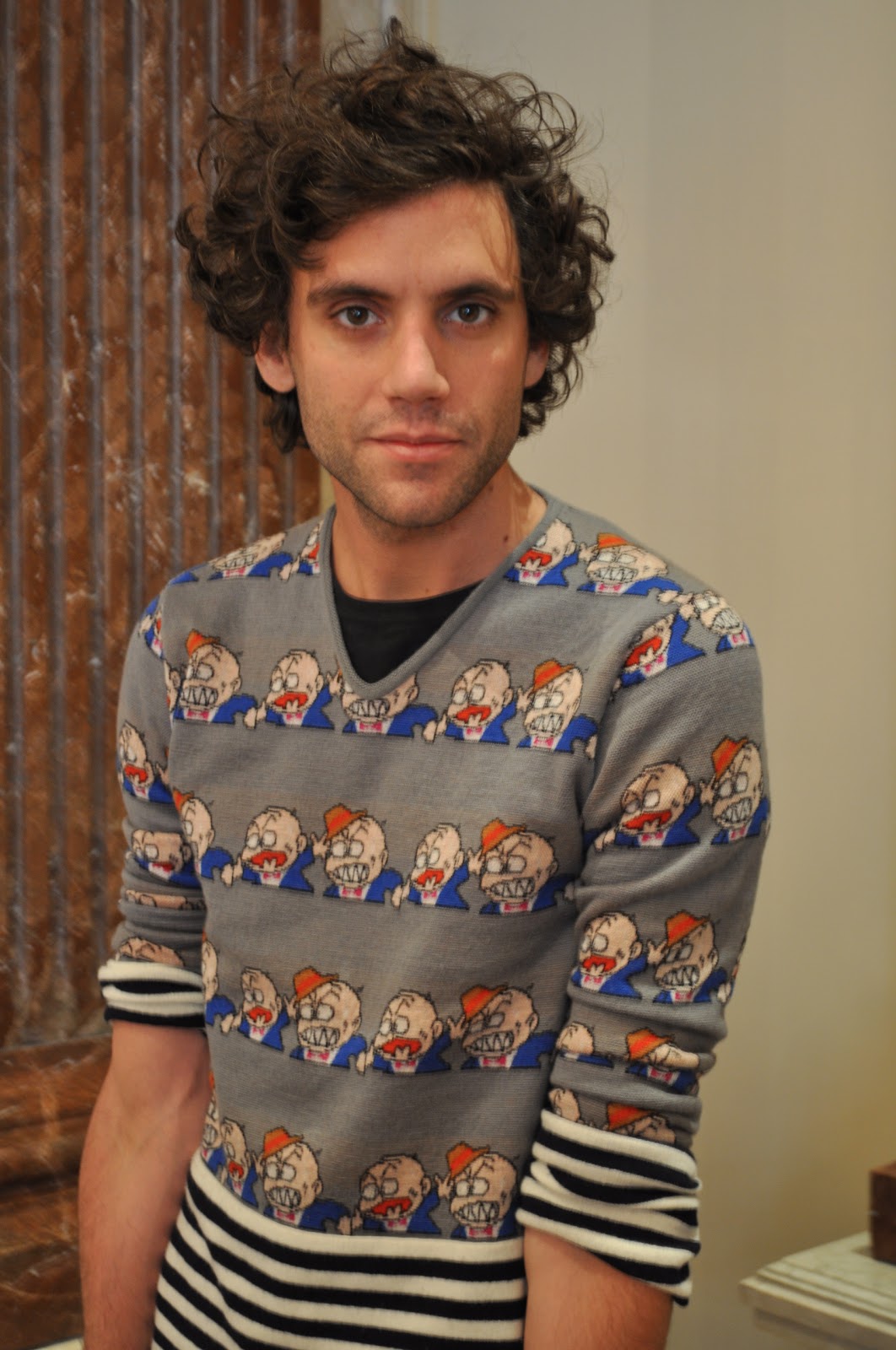
Mika in Kensington, London, on 28th April 2010
LONDON--As global pop phenomenon Mika enters the ornate lobby of a West London hotel, he is suddenly struck with a sense of deja vu. "I got signed in this hotel. It must have been four years ago," he said earlier this month.

The 26-year-old's basement audition led to the release of his debut album, Life in Cartoon Motion, in 2007 and his collection of catchy pop tunes were an instant hit, especially the single, "Grace Kelly" with lyrics that Mika says are about "a man saying that he was trying to be like a woman."

The Boy Who Knew Too Much, released in September, cemented the global popularity of his infectious melodies. Born in Beirut to a Lebanese mother and American father, Mika sees his upbringing as a major influence.

"Because I was born in Beirut, raised in France [with] an American influence, then raised in England, it transferred itself into my musical tastes. I was exposed to so many different types of music that, to me, music was not about a scene, or about an image or a statement--it was about how it made you feel. So it was totally normal to listen to a 1940s French crooner called Tino Rossi next to Shabba Ranks, next to a little bit of Nirvana. One was theater, one was drama, one was just beauty, one was sadness. That's how I still listen to music to this day and I think that that's where I get my sense of melody from," he said.

Spurred by his sense of melody, Mika drew on his international background when it came to songwriting.

"Everyone needs an impetus for writing a song. If you don't know who you are or where you belong, you create your own world and I think that's why so many songwriters, I think, have displaced dispositions--it's a nice way to put it. It can either f--- you up or you can use it to your advantage," he said.

The world that Mika creates in his music has its roots in fairy tales, especially the darker elements of traditional storytelling.

"I was obsessed with fairy tales, nursery rhymes, but I was also obsessed with Nostradamus when I was a child. I was convinced we were all gonna die.

"Part of growing up is part of understanding the concept of fear and I think that's what we use nursery rhymes for. But fairy tales are a very powerful thing because they enable you to talk about subjects that you'd normally never broach, or never want to get close to, and they deal with a lot of macabre things, in a very nicely presented way. To me, it's all about the gory fairy tales, the gothic fairy tale," he said.

This interest in the darker side manifested itself in The Boy Who Knew Too Much, with a melancholic mood that Mika compares to one of his lyrical contemporaries.

"It's a darker record. I'm sitting there thinking it's a collection of songs like 'Toy Boy' and 'Blue Eyes' that are these weird, twisted little fairy tales that have more in common with a Rufus Wainwright story," he said.

Mika's disjointed childhood also led to a feeling of alienation that he admits was an influence on his work.

"[I was] an outsider. My taste in music, probably, was different, and then as I grew up everything, my attitude towards sexuality--especially being in boys' schools--immediately made me an outsider. I think it drove me towards being good at something.

"I think you have a choice when you're isolated in your adolescence, or even as a child, and you can either waste your time assimilating yourself and wallpapering yourself so that you blend in with the background--which is, I think, dangerous--or you can claim your ground like some kind of mad maniac and just say, 'OK, this is where I've been placed, I'm gonna make this my own,' and build a wall around it by getting into music, by getting into this and by being really good, because then maybe they won't be able to touch me anymore. Maybe I won't have to make excuses or be afraid," he said.

One thing that Mika has never been afraid of is taking chances with his live performances and his shows in Japan will draw their inspiration from Charlie Chaplin's daughter and a minimal form of drama pioneered by a Polish theater director.

"It's completely new to what I had before. It's based on this French circus show I saw when I was a child--Victoria Chaplin's company, Le Cirque Invisible, and it's like [Jerzy Grotowski's] Poor Theatre. It's a very handmade, tactile show, it's like a macabre carnival," he said.

Mika will play at Zepp in Tokyo at 7 p.m. on June 7-8, (03) 3599-0710; Zepp in Nagoya at 7 p.m. on June 10, (052) 541-5758 and Namba Hatch in Osaka at 7 p.m. on June 11, (06) 4397-0572.
(May. 28, 2010)

Waraku Ensemble Interview in The Daily Yomiuri on 26th March 2010

It's time to relax with some shamisen

Stephen Taylor / Daily Yomiuri Staff Writer
Junnosuke Uehara of the Waraku Ensemble in Tokyo March 2010
It's springtime. As the cherry blossom season kicks off, the nation's parks will echo to the sound of drunken office workers serenading the sakura after too much to drink. But for those seeking a more sedate celebration of the pink stuff, Japanese Cafe Music by the Waraku Ensemble may be just the thing.

The five-piece band has taken almost a dozen pop songs from the past 40 years and arranged them for traditional Japanese instruments such as the shamisen, shakuhachi and koto.

"As this is cafe music, I wanted songs that are easy to listen to and familiar to a lot of people. So, we chose very popular songs associated with spring that everyone should know," Junnosuke Uehara, shamisen player for the Waraku Ensemble recently told The Daily Yomiuri in Tokyo.

The sound of the shamisen can be an acquired taste, yet Uehara's shamisen arrangements come as a very pleasant surprise.

"Some shamisen have a very harsh sound, but I can change the tone with bridges to match the cafe sound I'm trying to achieve. I can get different sounds from different bridges and different strumming techniques," he explained as he showed me his prized instrument made from the skin of a female cat.

Most of the tracks were written less than 40 years ago. Of those, the oldest is Haruomi Hosono's "Owari no Kisetsu" and the languid treatment the song is given can be appreciated even more after listening to the original version with its country-music backing.

One of the treats of the album was checking out the originals on Youtube and finding a young (and very pretty) Seiko Matsuda performing "Akai Sweet Pea" with Tetsuko Kuroyanagi on TV in the early '80s and discovering the charms of girl group the Candies. Two of their numbers, "Hohoemi Gaeshi" (Returning a smile with a smile) and "Haru Ichiban" (First spring breeze) from 1978 and 1976, respectively, are good fun and the lively arrangement of the latter tune also allows listeners in the know the chance to perform the group's distinctive hand jive--if they feel so inclined.

Uehara hopes to broaden the appeal of traditional Japanese music, not only overseas, but also domestically. The album's extensive liner notes give information about the songs, instruments and group members in both English and Japanese.

"I wanted to help traditional Japanese music to become known widely throughout the world, not in a difficult form--but a more accessible way.

"We've included a description of instruments, as a lot of people in Japan have never seen these traditional instruments. I wanted to trigger an interest in traditional Japanese culture by introducing the instruments," Uehara said.

Fusing traditional music with contemporary sounds can be a perilous undertaking, and Uehara admitted his "modernization" of shamisen music had received mixed reactions.

"Some of my contemporaries who play traditional Japanese music have been very positive about this project. Others feel you shouldn't mess with tradition, and are not quite so encouraging about experimenting with traditional instruments," he said.

Concertgoers will get a chance to judge for themselves when the Waraku Ensemble play in Tokyo next month. Uehara hopes a good time will be had by all.

"I want people to come and casually listen to the hit songs played in this manner and have a nice evening with great food and drink and enjoy the sounds," he said.

"Japanese Cafe Music" by the Waraku Ensemble is out now on Respect Records. The group will play at Eats and Meets Cay in Aoyama, Tokyo, on April 10 at 6:30 p.m. (03) 3498-5790
(Mar. 26, 2010) 

Biffy Clyro Interview in The Daily Yomiuri on 19th March 2010

Biffy Clyro keeps it all in the family

Stephen Taylor / Daily Yomiuri Staff Writer


Biffy Clyro at the Hostess office in Tokyo in March 2010
What is it about twins that fascinates people so much? Ben and James Johnston of the Scottish band Biffy Clyro can't see what all the fuss is about, though drummer Ben recognizes that the band are a tightly-knit unit.

"I think a lot of people put an onus on twins having this telepathy thing, this bond. But to be honest, I think any human beings who spend that amount of time together end up creating some kind of bond like that," Ben said when he and his bass-playing brother talked to The Daily Yomiuri in Tokyo earlier this month. James was quick to stress that all three members of Biffy feel like family.

"Because Ben and I are so close, it wouldn't work unless we shared the same thing with [singer/guitarist] Simon [Neil]. I think we're lucky the three of us really feel like a gang together, and I think that connection is there, both musically and personally, and I think that has been one of the determining factors of the band really, and the reason probably we're still doing it," he said.

One reason for the group's solid bond is the length of their friendship, which goes back to the early years of primary school. When Simon decided to form a band in high school with James and Ben, they settled on the name Biffy Clyro, the origins of which have remained clouded in mystery--until now...maybe.

"I think Simon came up with it in German class when we were at school. He was sitting thinking about an imaginary Cliff Richard Biro pen, which was a Cliffy Biro," Ben explained.

"And it became Biffy Clyro. That's the honest answer," added his brother.

The name is often called "Dylan Thomas-esque," according to the pair, who say that one of their previous explanations for the name's derivation actually played on that misconception.

"There actually is a place in Wales--and this is a complete coincidence--called Clyro. We had no idea, of course, and people have sent us e-mails with pictures of this sign [announcing] the town of Clyro.

"We've made up stories that Biffy Clyro was actually a Welsh astronaut that was meant to be the first man on the moon, but failed the physical," James said with a laugh.

One thing James and Ben agree on is their shared love of the guitar bands that came out of the Pacific Northwest of the United States during the grunge era of the late 1980s to mid-'90s.

"Nirvana, Soundgarden, Pearl Jam--the raw Seattle stuff was the basis of our first songwriting escapades, I guess. And then from there we got into more progressive stuff and more underground stuff. Then [we ended] up listening to anything we can get our hands on really," Ben said, a point upon which James expanded.

"It was bands like Mineral and Sunny Day Real Estate, kind of more complex types of music.

"I think we're continuing to evolve. One of my favorite bands now is Wilco, which is really relaxed and laid back," he said.

These days, the pair have no doubts about their favorite band.

"Like many other people of our age, Nirvana were the reason people picked up guitars, they were such seemingly ordinary guys, but making extraordinary music. You know, that's what made us want to do it, but eventually you can't sound like Nirvana, that's not fair, and I think we are our favorite band now," Ben said.

"I think we're proud of everything we've done. We could go out tomorrow and play [debut album] Blackened Sky from start to finish and be very proud of it, you know. Maybe people see that as us being cocky, but Biffy Clyro are certainly my favorite band," James added.

The band's fifth album, Only Revolutions, was released domestically in December and most of the tracks were included in an intimate show in Tokyo earlier this month. Two years ago, Biffy Clyro played at Summer Sonic and anyone who was at this month's show will be hoping the group return for this year's festival in August. If so, one item of clothing they won't need to worry about packing are stage shirts.

"It's so much fun to play with your shirt off. It's not meant to be any kind of, 'Check us out, we've got our tops off'...It certainly isn't a gimmick in any way; it's literally we play better with our shirts off.

"I was wearing shorts last night--I never do that--and it felt so good. I might even be naked the next time we play," Ben said to the sound of a big laugh from James.

Only Revolutions is out now on 14th Floor/Hostess.
(Mar. 19, 2010)

Alison Mosshart (The Dead Weather) interview in The Daily Yomiuri on 12th March 2010

The Weather's fine for Kills' Mosshart
Stephen Taylor / Daily Yomiuri Staff Writer

Supergroups--as 1960s as free love and "groovy, baby"--are back. Only this time, with a bit more attitude and not quite as much self-indulgence.

The Dead Weather--formed by Jack White of the White Stripes/Raconteurs and Alison Mosshart of the Kills--will be in Tokyo later this month and, according to Mosshart, relishing the prospect.

"I'm looking forward to the gig, 'cause it's great playing in Japan," she told The Daily Yomiuri over the phone from Michigan last month.

The seeds of the Dead Weather were sown during a tour featuring White and Mosshart.

"The Kills did a tour with the Raconteurs. Jack lost his voice so I was singing some songs for him...he said it'd be a great idea that I come to [Nashville] to record something," she said.

Those sessions led to the Dead Weather's debut album, Horehound, which came out last year and forced its way into the Top 20 on both sides of the Atlantic.

While that album was the result of short, sharp sessions, the follow-up has followed a slightly different route.

"We wrote a lot of stuff on the road when we were touring, through soundchecks and stuff. Any time we had off between tours, we'd just go back into the studio and work, so we'd have two days recording here, three days here," she said.

The group recently finished recording its follow-up to Horehound, though no release date has been set. Nevertheless, Mosshart is looking forward to giving the audience at Zepp Tokyo a sneak preview.

"We can't wait to play it, we'll definitely be playing it," she said.

While Mosshart could not reveal the title of the new record, she was able to throw some light on the origins of Horehound.

"That was a candy that Jack had seen and he loved that word. He was like, 'I think that sounds like a fast car, I really like that,'" she said. Horehound candy is flaored with an extract from a plant of the same name.

Playing in two groups could be a problem for some musicians, but Mosshart appears to enjoy the challenge.

"I think the ways of working are so different. The relationships are so different, it doesn't feel confusing. I've been in the Kills for nine years, I know what it's about, and so it's kinda like coming home, you know. The Dead Weather's all new and we're still figuring out everything. It's very different," she said.

The Dead Weather will play at Zepp Tokyo in Odaiba, Tokyo, on March 31 at 7 p.m. (03) 3599-0710.
(Mar. 12, 2010)

Steven Berkoff Interview in The Daily Yomiuri on 12th March 2010

At home in Japan: British director Steven Berkoff finds the art of acting alive and well halfway around the world

Stephen Taylor / Daily Yomiuri Staff Writer

Steven Berkoff with the writer in Tokyo in March 2010

"What I like about kabuki is that it makes the art of the actor on the level of an opera singer or a ballet dancer or a classical pianist."

As British theater director Steven Berkoff took a break from rehearsals for his production of a play based on Franz Kafka's The Metamorphosis (Japan title: Henshin) in Tokyo last month, he told The Daily Yomiuri why he was eager to get back to the roots of one of his favorite art forms after 18 years away from Japan.

Having spent the previous evening watching kabuki, the 72-year-old veteran expanded on his admiration for traditional Japanese theater, in stark contrast to his opinion of its counterparts elsewhere.

"[Kabuki] dignifies the art of acting, which has been undignified for many years. [Acting has] been so undignified...in the end any idiot can act, and very often they do," he said.

This production of The Metamorphosis--which runs until March 22 in Tokyo before a national tour--stars Mirai Moriyama as protagonist Gregor, the office clerk who wakes up one morning to discover that he has turned into a beetle. It was first adapted for the stage by Berkoff 41 years ago, and the Londoner last visited Japan to direct the same play. This time, he sees no reason for the production to undergo a drastic metamorphosis.

"Once you've evolved something and that's taken you years, you don't want to change it--'Oh, I think I'll do something else now'-- there'd be no point, but I interpret it according to the actors I've got. So I keep the form, but they will change it accordingly. We have a different Gregor--Mirai [Moriyama]--and he's extraordinarily different. I just let him do what he more or less wants, because he's so inventive," Berkoff explained.

Unlike some non-Japanese theater directors, Berkoff is comfortable with the slightly more hierarchical relationship between actors and directors in Japan. "In England, I've worked with a lot of actors who've got attitude--even arrogance--and [say] 'Oh, I don't know why I should do this or that.' I don't find that here. I find it's not servility, it's a kind of respect for the art and if you're the director you're the boss. Maybe it's to do with Japanese culture and the respect for authority, but I like that, that they do listen, that they're keen.

"I'm proud to be doing this, because it's a serious play, in a serious city, with a serious company, so this is me," he said.

The tale is a classic piece of European literature, one that Berkoff feels will strike a chord with Japanese audiences.

"They would think it's Japanese--totally familiar. It's an allegory, a fairy tale, a moral tale, it is directed with gesture and movement--it'll be totally familiar to them, it wouldn't be at all alien; in fact they probably would think I'm Japanese," he said.

While Berkoff may be satisfied with his production in Japan, he expressed despair at the state of theater in Britain.

"The English public have been suckered--they've been taken for suckers by a whole heap of trash--and I think it's shocking. I really think they have been like children, they've been given bad food and I think it's absolutely terrible," he said.

According to Berkoff, the source of this "bad food" is a new breed of theater directors who have never actually trod the boards themselves.

"Any actor is a good director. Actors are wonderful because once they tap into it, they can do it. I've always enjoyed being directed by an actor, they understand your problems," he said.

Having performed on the stage since the early 1960s and appeared in a number of Hollywood movies, such as Beverly Hills Cop, Octopussy and Rambo: First Blood Part II, Berkoff fits his own criteria for directing. It is on the stage where his heart most definitely lies, and he is particularly proud of being perhaps the greatest thorn in the side of British theater.

"The establishment likes to have thorns. It keeps them going, and the thorns are a little bit like when you do acupuncture--it strengthens the immune system. So I suppose I am a thorn, possibly, but it is better to be a thorn than to be part of [the establishment]."

The play will be performed in Japanese, though Berkoff is so familiar with the text that the language barrier should not be an obstacle for him.

"I know where the emotions lie, the color lies, the movement lies. I've also directed it in German, and in Hebrew. I directed it in American, of course, and in Australian--'cause they're two different languages--but actors are very similar all around the world," he said.

As for its relevance for contemporary audiences, Berkoff concedes that he has no qualms about moving with the times, if necessary.

"I have always been ahead of the game anyway. Years and years ahead, though now they're catching up with me a little bit, though not much. An astute observer may say, 'Oh...I've seen that, it's a bit dated,' perhaps, but I don't think so, because as I redo it, anything that's dated I sense and I cut, get rid of," he said.

Berkoff's forthright nature is invigorating, though some people might label him a cantankerous old devil. Yet it is this passion that has resulted in some of the most pioneering and, at times, radical theater of the past 40 years. Even in his 70s, Berkoff's belief remains strong.

"I think I probably have a great deal more [passion than in my youth]--it's peculiar. I feel a lot more deeper and I've become more politicized and I've realized how important this work is, not because it's me, but because I was lucky enough to choose the kind of work that means something to people," he said.

"The Metamorphosis" (Japan title: "Henshin"), based on the story by Franz Kafka and directed by Steven Berkoff, is at Le Theatre Ginza in Ginza, Tokyo, until March 22, (03) 3477-5858, and will move to Okayama Shimin Kaikan in Okayama on March 31, (086) 903-2001; Sankei Hall Breeze in Osaka on April 2-4, (06) 6341-8888; Fukuoka Shimin Kaikan in Fukuoka on April 6, (092) 715-0374; Aubade Hall in Toyama on April 11, (025) 245-5100; and Ryutopia in Niigata on April 13, (025) 224-5521.
(Mar. 12, 2010)